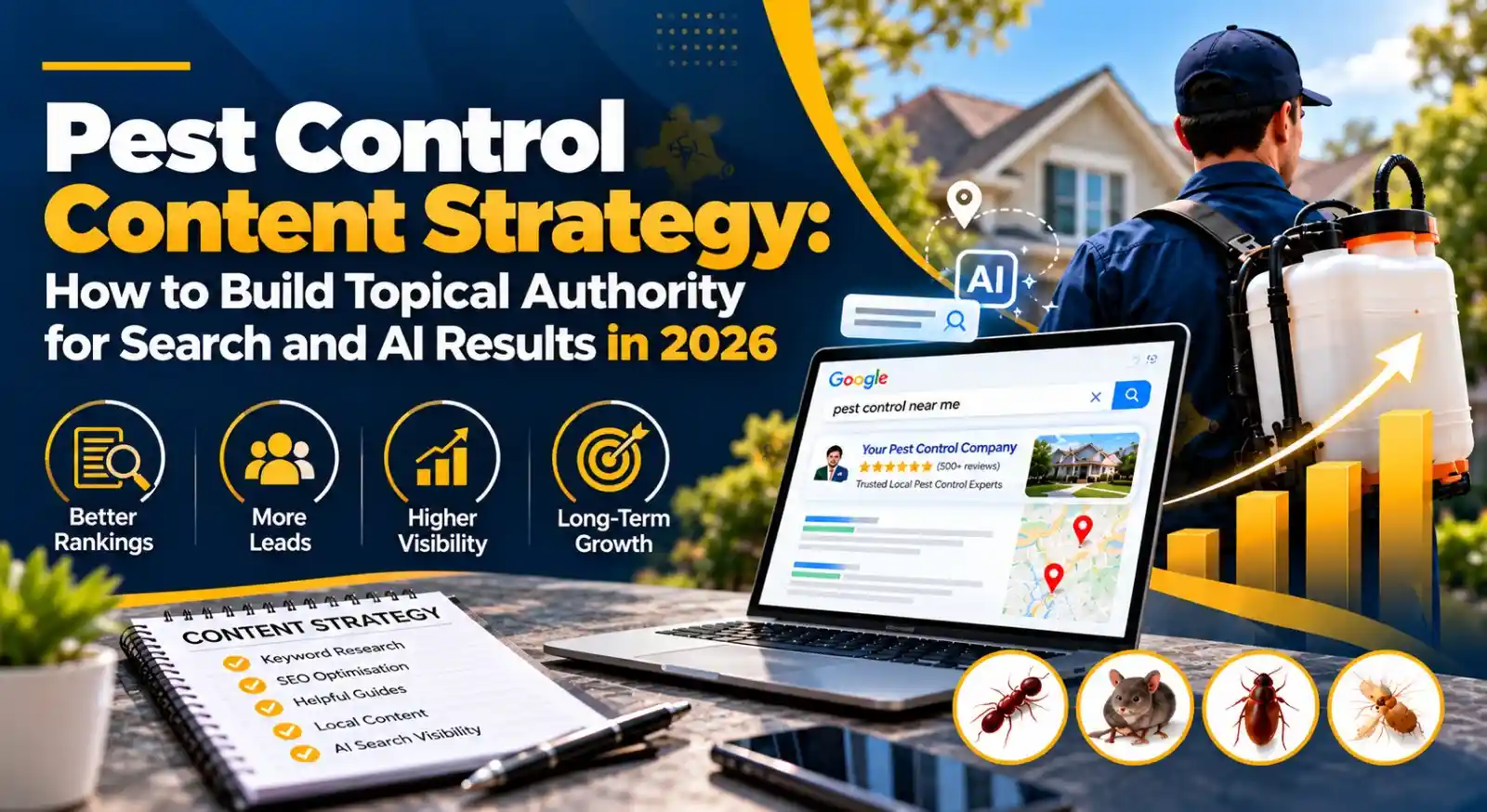
Pest Control Content Strategy: How to Build Topical Authority in 2026

SEO Expert
- SEO
October 7, 2026
A pest control website can publish new blog posts every week and still struggle to gain meaningful search visibility.
The problem is often not a lack of content. It is a lack of direction.
One article talks about termites. Another covers ants. A few posts mention seasonal pests, while the main service pages receive little support. Nothing connects the topics, and very little content helps a potential customer move from a question to a service.
A pest control content strategy solves that problem by giving every piece of content a clear purpose. Instead of publishing random articles, you build a useful information system around the services, pests, locations, and questions that matter to your business.
That approach is especially useful in 2026, when customers use traditional search as well as increasingly conversational and AI-driven search experiences. Google says its guidance for generative AI search still relies on strong SEO fundamentals, with an emphasis on valuable, unique content that gives people something useful.
What Is a Pest Control Content Strategy?
A pest control content strategy is a plan for deciding what your company should publish, who each piece is for, what question it answers, and how it supports your services.
For a pest control company, that could mean building content around termite control, rodent removal, bed bug treatment, mosquito control, commercial pest management, or general pest prevention.
The important part is the relationship between the pages.
A guide about termite warning signs should have a natural connection to your termite service page. An article about mice entering homes can support a rodent control service. A local page can explain where the company operates and link visitors to the services available there.
The result is a website that makes more sense to customers and gives search engines clearer context about what the business knows and provides.
Why Random Blog Posts Usually Do Not Build Authority
Many pest control companies approach content by asking, “What should we write about this week?”
That can produce articles, but it does not necessarily produce a strong website.
A better question is, “What does our customer need to know before choosing this service?”
For example, if termite control is an important service, one article about termites is not enough. Customers may want to understand how to identify termite activity, when an inspection is necessary, how treatment works, what preparation involves, and how to prevent future problems.
Those questions can become a connected group of useful pages.
This is the practical meaning of topical authority for pest control. It is best treated as a content architecture concept, not a guaranteed Google ranking factor. You build depth around an important subject so the website becomes a more complete resource instead of a collection of unrelated posts.
Build Content Around Your Core Pest Control Services
Your content strategy should begin with the services that matter to your business.
If termite treatment generates substantial revenue, start there. If your company wants more commercial accounts, build content around commercial pest management rather than publishing dozens of general homeowner articles.
Create a Main Topic and Supporting Content
Think of your main service page as the center of a topic.
For termite control, supporting content might answer questions about termite signs, inspections, treatment methods, prevention, seasonal activity, and what homeowners should do after discovering an infestation.
The supporting pages should not simply repeat the service page. Each should answer a different question and then guide readers toward the relevant service when appropriate.
This creates a useful relationship:
Customer question → helpful answer → related service → contact
That is much stronger than adding keywords to unrelated blog posts.
Match Content to Different Search Intents
Not every person searching about pests is ready to hire an exterminator.
Someone searching “what do termite droppings look like?” is trying to identify a problem. Someone searching “termite inspection near me” is looking for a professional. Someone searching for a termite company in a specific city is comparing local providers.
Your pest control content SEO strategy should account for those differences.
Informational searches usually need educational content. Service searches need detailed service pages. Local searches need useful location and business information.
When each page has a clear purpose, your website becomes easier to navigate and less likely to have several pages competing for the same topic.
Is Your Pest Control Content Actually Supporting Your Services?
Publishing more articles will not necessarily create more business. Your content should answer real customer questions, support important services, and create clear paths from information to action. Get a free content and SEO review to identify gaps and opportunities across your pest control website.
Free analysis • No obligation • Built for pest control businesses
Use Local and Seasonal Content Strategically
Pest control is strongly connected to geography and seasonality.
A pest problem that receives attention in Florida may not have the same importance in New York. Even within the same state, weather, housing, commercial activity, and local pest patterns can influence what customers search for.
A company serving Staten Island, NY, for example, can create content that reflects the pests and customer concerns relevant to its actual market.
Seasonality also gives you a natural planning framework. Termite activity, mosquitoes, rodents, and other pests can create different customer concerns throughout the year.
The key is to publish useful information before customers reach peak demand, rather than waiting until everyone is already searching.
Make Local Content Actually Local
Avoid creating dozens of pages that are identical except for the city name.
A useful local page should explain the services available in that area and provide information that makes sense for customers there.
Effective local SEO services should also incorporate real company experience, service examples, customer questions, or community information when those details are genuinely relevant.
That is more useful than creating pages simply because a keyword tool shows another city variation.
Build Content That Demonstrates Real Expertise
Pest control is an industry where practical experience can make content much better.
A technician may know the questions homeowners repeatedly ask, the mistakes customers make before treatment, and the signs that often lead to a professional inspection.
Those insights are valuable.
Instead of writing another generic article called “10 Pest Control Tips,” explain something specific that helps the reader make a better decision. Describe what customers should look for, when a problem may require professional attention, and what they can expect from a service visit.
Google’s people-first guidance encourages content that demonstrates first-hand expertise, provides original value, and leaves readers feeling that they learned enough to accomplish their goal.
Connect Content With Your Service Pages
Content should support the business, but it should not feel like advertising.
If an article explains the signs of a rodent infestation, it is reasonable to link to the company’s rodent control service. If a guide explains why professional termite inspections matter, a link to the termite service is useful.
This is where internal linking becomes important.
Your blog should help readers discover relevant services, while your service pages can link back to useful educational resources.
You can also connect your content strategy with your broader Pest Control SEO Services and Local SEO for Pest Control strategies.
Make Content Useful for Search and AI Experiences
AI-powered search does not mean you need to create a separate article for every possible question.
The better approach is to make your existing content clear, complete, and genuinely useful.
Explain the topic directly. Use descriptive headings. Answer important questions in plain language. Connect related information. Make it clear who provides the service, where it is available, and what customers can expect.
Google’s 2026 guidance specifically says that SEO best practices remain foundational for appearing in generative AI features and emphasizes valuable, unique content rather than special “AI optimization” tricks.
That means a strong pest control content strategy should focus on information quality first.
Measure Whether Content Is Helping the Business
Traffic alone is not enough.
An article may receive thousands of visits but generate little business. Another page may receive fewer visitors but bring customers searching for a valuable service.
Track which pages attract organic traffic, which queries generate impressions and clicks, which service pages receive visits from content, and whether organic visitors become calls, forms, inspections, or booked jobs.
Also review older content. If an article is outdated, inaccurate, or no longer useful, improve it rather than publishing another page covering the same subject.
Frequently Asked Questions
How does a pest control content strategy help SEO?
It creates a connected set of useful pages around your important services, customer questions, and locations, giving your website broader and more organized topical coverage.
What is topical authority for pest control?
It is a content strategy concept focused on building meaningful depth around important pest control subjects. It should not be treated as a guaranteed Google ranking factor.
How often should a pest control company publish content?
There is no required publishing frequency. Consistent, useful content is more valuable than publishing large amounts of repetitive material.
Should pest control blogs link to service pages?
Yes, when the link genuinely helps the reader. An article about termite problems can naturally lead to a relevant termite treatment or inspection service.
Can pest control content appear in AI search results?
Potentially. Google says its generative AI search features continue to rely on foundational SEO practices and valuable, unique content. There is no guaranteed method for earning an AI-generated citation.
Conclusion
A strong pest control blog strategy is not a publishing schedule filled with random topics. It is a structured way to build useful information around the services your business actually wants to grow.
Start with your core services, understand the questions customers ask, organize related topics, add genuine industry knowledge, connect useful content with service pages, and measure whether the work contributes to qualified leads.
For U.S. pest control companies competing in 2026, that approach creates a stronger website for customers and a clearer information structure for search engines and emerging AI search experiences.
Ready to Turn Your Pest Control Content Into a Growth Channel?
Your content should do more than attract visitors. Our Pest Control Content Marketing approach helps organize your topics around customer needs, important services, and search opportunities so your website can provide useful information and guide potential customers toward the right solution.
Get Your Free Content Strategy Review →Free strategy review • No obligation • Focused on useful content and business growth
About the Founder:
Rao Adnan Mohyuddin
Founder of Pest Control SEO Service
Rao Adnan is the founder of Pest Control SEO Service. He leads a team that has worked with many pest control companies, helping them grow with SEO, local search, and digital marketing.