10 Pest Control SEO Tips That Actually Move the Needle

SEO Expert
- SEO
July 21, 2026
When someone finds pests in their house, they’re not casually browsing they’re searching with real urgency, and they’ll usually call the first trustworthy business they find within about 5 to 10 minutes. That short window can be worth anywhere from $100 to $2,000 depending on the job. SEO for pest control isn’t about generic best practices it’s about making sure you’re the business showing up in that narrow window. Here are 10 tips that actually make a difference.
1. Win the Google Map Pack First
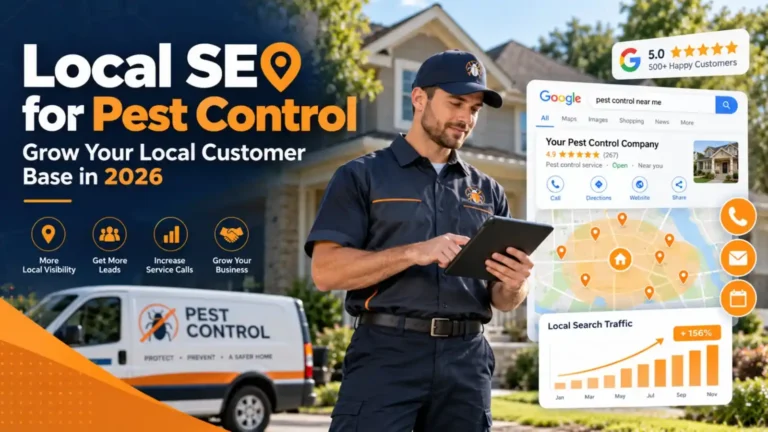
Most pest control searches are local, and the map pack (the block of three local results at the top of Google) captures the majority of those clicks. Reviews are the single biggest ranking factor here set up a system to text a review link to every customer right after a completed job, and respond to every review you get. Beyond reviews, make sure your Google Business Profile is fully filled out: accurate hours, real photos, complete service categories (“Pest Control Service,” “Exterminator,” “Termite Control”), and a verified address.
2. Build Service + Location Pages — Carefully
Dedicated pages for each service in each area you serve (“Termite Treatment in [City],” “Bed Bug Removal in [Neighborhood]”) work far better than one generic page trying to cover everything. But there’s a real trap here: if you build these pages by simply swapping the city name into an identical template, Google sees them as duplicate content and may not index most of them at all. Each page needs genuinely unique details local landmarks, area-specific pest pressures, real testimonials from that area not just a find-and-replace job.
3. Target Buying Intent, Not Just Broad Keywords
“Exterminator near me” and “termite inspection [city]” signal someone ready to hire. “How to get rid of ants myself” signals someone trying to avoid hiring anyone. Structure your content and keyword targeting around the searches that actually convert, and don’t waste page real estate chasing high-volume terms that bring in the wrong kind of visitor.
4. Structure Content for AI Overviews, Not Just Traditional Rankings
More than 40% of searches now trigger an AI-generated overview before a user ever sees a traditional listing. Getting cited inside these summaries depends on clear, well-structured content: direct answers near the top of the page, genuine FAQ sections, and schema markup that tells search engines exactly what your business does and where you serve. Ranking #1 the old way still matters, but it’s no longer the whole game.
5. Get the Technical Basics Right
A slow, poorly structured site quietly caps how well even great content can perform. Make sure your sitemap updates automatically as you add new service or location pages, your robots.txt file isn’t accidentally blocking pages you want indexed, and your site has a clear internal linking structure connecting related service and location pages to each other. None of this is glamorous, but skipping it limits everything else you do.
6. Keep Your Business Information Identical Everywhere
Your name, address, and phone number need to match exactly across your website, Google Business Profile, Yelp, and every directory you’re listed on. A single wrong digit in your phone number on one directory can cost you real emergency calls customers won’t call back to double-check, they’ll just call the next result. A citation management tool makes this easy to monitor across dozens of listings at once.
7. Build Content Around the Pest Calendar, Not Just Evergreen Topics
Ant and mosquito searches climb in spring and summer. Rodent searches climb in fall and winter. Termite searches often spike in early spring during swarming season. Publishing content timed to these real seasonal shifts a few weeks ahead of when the search volume actually rises captures demand right as it builds, instead of competing for attention once everyone else has already published the same seasonal post.
8. Earn Real Backlinks, Not Directory Spam
Backlinks remain one of the strongest ranking signals, but a pile of low-quality directory links does far less than a handful of links from genuinely relevant local sources a local news mention, a homeowners’ association newsletter, a partnership with a real estate or property management company. Outreach for this kind of link is slower and more manual than submitting to directories, but it’s what actually moves rankings for a competitive local term.
9. Use Case Studies and Testimonials as More Than Just Trust Signals
A detailed case study a specific pest problem, what you did, and the result builds credibility with potential customers reading your site, but it’s also the kind of content other sites are more willing to reference or link to than a generic service page. Real results with real specifics do double duty: conversion tool and link-earning content at once.
10. Match Keywords to Intent, Not Just Volume, in Your On-Page Content
Use your target keyword naturally in the first 100 words, in your headers, and in your title tag and meta description but write for the person reading it first, and the algorithm second. The keyword-stuffing approach that used to work for local service businesses doesn’t hold up anymore; Google is far better now at understanding intent and quality regardless of exact keyword matching, and content that reads naturally consistently outperforms content that reads like it was written for a crawler.
Bottom Line
Pest control SEO isn’t complicated in concept it’s just unforgiving of shortcuts. A strong Google Business Profile, genuinely local content instead of templated pages, technical fundamentals in place, and consistent business information across the web will outperform any single “trick” you might read about elsewhere. Do the fundamentals well and consistently, and you’ll be the business showing up in that 5-to-10-minute window that actually gets the call.
If you’d rather have this entire strategy local SEO, content, and technical fixes built and managed by a team that works exclusively with pest control companies, Pest Control SEO Service offers a free audit to show you exactly where you stand.
About the Founder:
Rao Adnan Mohyuddin
Founder of Pest Control SEO Service
Rao Adnan is the founder of Pest Control SEO Service. He leads a team that has worked with many pest control companies, helping them grow with SEO, local search, and digital marketing.